How to Choose the Right Painting Line for Your Factory?
Choosing the right Painting Line can determine your factory’s quality, output, energy use, and long-term operating cost. It is not simply a purchase between spray booths, ovens, conveyors, and controls. The line must fit your products, floor space, production rhythm, coating materials, and workforce.
Industrial finishing consultant Jim Kavanagh offers a practical warning: “The cheapest line is rarely the lowest-cost line.” This principle deserves attention when comparing manual, semi-automatic, and fully automatic systems. A line designed for small metal cabinets may struggle with large frames, irregular parts, or frequent color changes. A conveyor that moves too quickly can leave thin edges, while an oven with uneven airflow may create visible gloss differences.
Real conditions matter.
Inspect the factory floor before choosing equipment. Measure ceiling height, loading areas, ventilation routes, and maintenance access. Consider how operators will hang a 40-kilogram component at the start of each shift. Calculate curing temperature, conveyor speed, compressed-air demand, and daily coating volume. These details reveal whether the proposed Painting Line is genuinely suitable.
Even experienced teams make mistakes. Forecasts can be too optimistic, and product designs may change after installation. That is why a flexible layout, accessible controls, reliable filtration, and documented testing deserve serious attention. Ask suppliers for application results on similar materials. Request energy data, maintenance schedules, and realistic capacity figures. A convincing demonstration is useful, but it is not complete proof. The strongest decision combines measured performance, operator experience, safety requirements, and honest reflection about what the factory may need five years from now.
Factory Painting Line Basics and Core Components
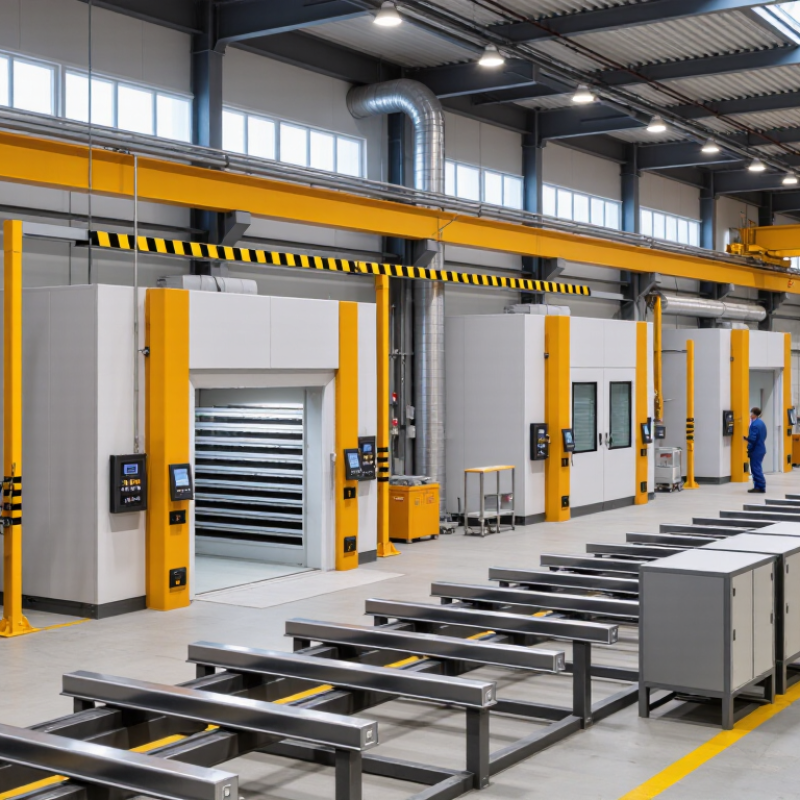
Choosing a painting line starts with process basics, not equipment catalogs. Map the substrate, coating chemistry, target output, part dimensions, and required finish. A complete line usually includes loading stations, pretreatment tanks, rinsing, drying, spray booths, filtration, curing ovens, conveyors, and inspection points. Each component affects the next one. Poor cleaning can ruin an excellent coating system.
Energy deserves early attention. The International Energy Agency’s Energy Efficiency 2023 report places industry at about 37% of global final energy demand. Oven insulation, heat recovery, variable-speed drives, and accurate temperature controls can reduce avoidable consumption. The U.S. Department of Energy reports that compressed-air leaks may waste 20–30% of compressor output. Check hoses, regulators, and blow-off nozzles during commissioning. Small leaks become permanent operating costs.
Ventilation must protect finish quality and workers. Airflow should be balanced across the booth, oven, and surrounding work areas. Pretreatment chemistry needs documented concentration checks, bath-temperature control, and scheduled replacement. Conveyor speed should match flash-off and curing requirements, rather than simply maximizing parts per hour. A faster line can create under-cured films, overspray, and rework. The European Commission’s Surface Treatment of Metals and Plastics BREF emphasizes emission control, resource efficiency, and process monitoring. Yet no report replaces a floor trial. Layout drawings often miss maintenance access, awkward part loading, and dust near doors. These details can make a technically correct line frustrating to operate.
| Selection Dimension | Typical Options | Best-Fit Application | Key Technical Considerations | Indicative Performance |
|---|---|---|---|---|
| Workpiece Material | Carbon steel, stainless steel, aluminum, galvanized steel, plastics, or mixed substrates | Choose a process that matches the substrate and its corrosion, adhesion, and heat-resistance requirements. | Surface preparation chemistry, pretreatment temperature, drying temperature, paint compatibility, and grounding requirements must be verified for each material. | Critical factor |
| Product Size and Weight | Small components, medium assemblies, long profiles, large cabinets, frames, or vehicle bodies | Determines conveyor design, booth dimensions, oven capacity, hanger spacing, and loading method. | Confirm maximum length, width, height, weight per hanger, center of gravity, and minimum clearance between products. | Must be defined before layout |
| Required Coating Process | Liquid spray painting, powder coating, electrophoretic coating, or a combined system | Liquid paint suits a broad range of finishes; powder coating is widely used for durable industrial coatings; electrophoretic coating is common for uniform corrosion protection. | Consider coating chemistry, film thickness, color-change frequency, curing requirements, wastewater treatment, and operator skill. | Process-dependent |
| Pretreatment System | Wipe cleaning, spray washer, immersion tank, multi-stage spray pretreatment, or abrasive blasting | Selected according to contamination level, production volume, substrate type, and required corrosion resistance. | Typical stages may include degreasing, rinsing, surface conditioning, phosphating or zirconium-based treatment, final rinsing, and drying. | Directly affects adhesion |
| Drying and Curing | Flash-off chamber, drying oven, convection curing oven, infrared heating, or hybrid heating | Use the heating method specified by the paint or powder manufacturer and validated through production trials. | Oven temperature must be evaluated by actual part temperature and dwell time, not only by air temperature. Uniform airflow is essential. | Typically 80–220°C, depending on coating |
| Conveyor Configuration | Overhead power-and-free conveyor, continuous overhead conveyor, floor conveyor, monorail, or reciprocating system | Overhead conveyors suit hanging parts; floor conveyors are useful for heavy or large products; power-and-free systems support buffering and variable takt time. | Calculate line speed from takt time, pitch, process dwell time, product weight, and accumulation requirements. | Common line speed: about 1–6 m/min |
| Paint Booth Design | Open-front booth, enclosed spray booth, dry-filter booth, wet booth, or powder spray booth | Choose according to paint type, overspray control, solvent loading, environmental regulations, and required finish quality. | Airflow, filtration, exhaust capacity, booth pressure, fire protection, and hazardous-area electrical classification require professional design. | Safety-critical component |
| Ventilation and Air Management | Supply-air make-up system, filtered booth air, exhaust fan, heat recovery, and air-balancing controls | Maintains stable spray conditions, removes overspray and vapors, and protects workers and finished surfaces. | Air volume must be matched to booth size and process requirements. Excessive airflow increases energy consumption and may disturb coating application. | Required for stable quality |
| Automation Level | Manual, semi-automatic, robotic spraying, automatic color change, or fully integrated line control | Manual systems fit varied products and low-to-medium volume; automation is beneficial for repeatable geometry, high volume, and strict finish consistency. | Evaluate product mix, annual operating hours, labor availability, recipe management, inspection requirements, and return on investment. | Depends on volume and variety |
| Production Capacity | Low-volume batch production, mixed-model production, or high-volume continuous production | Batch lines provide flexibility; continuous lines provide higher output and consistent process control. | Capacity is governed by the bottleneck process, conveyor pitch, curing time, loading efficiency, changeover time, and planned operating hours. | Capacity must be calculated from takt time |
| Color and Product Changeover | Single color, limited colors, frequent color changes, or multi-product production | Frequent changes require efficient booth cleaning, powder recovery or paint flushing, dedicated circuits, and recipe control. | Consider color sequence planning, purge material, cleaning time, contamination risk, spare guns, and recovery-system design. | Higher changeover complexity |
| Quality Control Points | Visual inspection, coating thickness measurement, gloss measurement, adhesion testing, curing verification, and corrosion testing | Use inspection points after pretreatment, application, curing, and final finishing. | Common instruments include wet-film gauges, dry-film thickness gauges, gloss meters, cross-cut tools, and oven data loggers. | Essential for repeatability |
| Energy and Utility Demand | Electricity, natural gas or other approved fuel, compressed air, process water, ventilation air, and wastewater treatment | Utility selection depends on oven type, line speed, booth airflow, operating schedule, and local infrastructure. | Ovens and ventilation normally represent major energy loads. Heat recovery, insulation, variable-frequency drives, and standby controls can reduce consumption. | Perform a utility-load study |
| Environmental and Safety Controls | VOC control, powder overspray recovery, wastewater treatment, fire protection, grounding, interlocks, and personal protective equipment | Required for safe operation and compliance with local occupational, fire, air-emission, and wastewater regulations. | Solvent-based coatings may require explosion-protection measures; powder systems require effective grounding and combustible-dust control. | Mandatory design requirement |
| Factory Space and Layout | Compact batch cell, straight-through line, U-shaped line, or multi-zone continuous line | The layout should support material flow from loading through pretreatment, drying, painting, curing, inspection, and unloading. | Reserve space for maintenance access, exhaust ducts, utility routes, fire exits, spare parts, chemical storage, and future capacity expansion. | Plan access and expansion space |
| Core Components Checklist | Loading area, conveyor, pretreatment equipment, drying oven, spray booth, paint or powder equipment, curing oven, exhaust system, control cabinet, and inspection area | A complete line should integrate all process zones rather than treating the booth or oven as an isolated machine. | Specify equipment interfaces, sensor locations, emergency stops, PLC controls, maintenance access, spare parts, and commissioning requirements. | Complete-system approach |
| Recommended Selection Sequence | Define product data → select coating process → determine capacity → design pretreatment → size booth and oven → select conveyor → verify utilities and compliance | Use this sequence to prevent a line from being oversized, undersized, or incompatible with the coating specification. | Validate the concept with representative workpieces, coating trials, heat-profile testing, capacity calculations, and a total cost of ownership review. | Best-practice workflow |
| Important Planning Note | Performance figures are indicative industry ranges. Final equipment specifications must be confirmed through product samples, coating technical data sheets, local regulations, site conditions, and a detailed engineering assessment. | Verify before purchase | ||