7 Magnetic Starter Buying Tips for Global Buyers
Buying a Magnetic Starter can look straightforward, yet small specification errors may create expensive problems. A reliable choice must match the motor’s voltage, frequency, rated current, starting method, and operating environment. Global buyers also need to check whether the starter suits local electrical practices and recognized safety standards. A mismatch may cause nuisance tripping, overheating, or early contact wear.
This guide presents seven practical buying tips for international procurement teams. It focuses on real details, including thermal overload protection, enclosure design, coil voltage, terminal quality, and replacement-part availability. A supplier should provide clear datasheets, test records, wiring diagrams, and traceable product information. Photographs help, but they cannot replace technical documents. Ask for samples when the application involves pumps, compressors, conveyors, or frequent starts. A five-minute inspection may reveal loose terminals or weak labeling.
Cost still matters. However, the lowest quotation may hide poor copper contacts, limited warranty support, or uncertain delivery. Experienced buyers compare total ownership costs, not only the purchase price. They also confirm packaging strength for long-distance shipping and verify whether after-sales support operates across time zones. No checklist removes every risk. Even a reputable supplier can misunderstand an unusual motor duty. That is why written confirmation, independent inspection, and a controlled site test remain valuable. These steps may feel slow, but they protect production schedules and purchasing credibility. A careful buyer should remain skeptical, especially when specifications seem unusually attractive.
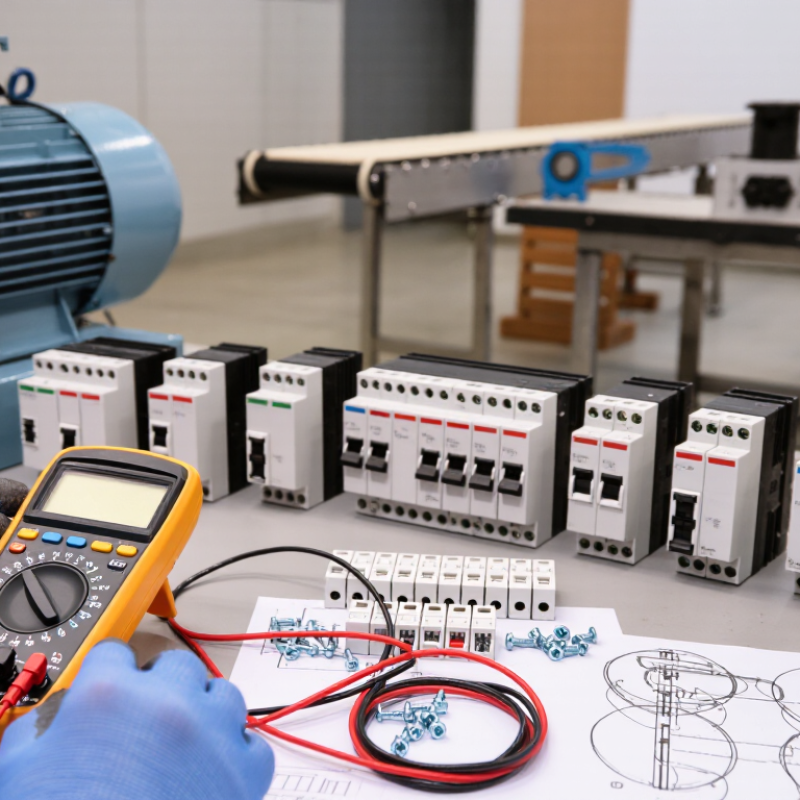
Understand Magnetic Starter Types and Motor Applications
Choosing a magnetic starter begins with the motor, not the catalog page. A full-voltage non-reversing starter suits pumps, fans, and simple conveyors. It applies line power directly to one rotation direction. A reversing starter adds interlocking contactors for forward and reverse movement. This fits hoists, machine tables, and some conveyor systems. Reduced-voltage starters can limit starting stress on larger motors, but they need careful motor and load matching.
Check the motor’s voltage, phase, rated current, and starting method. The starter’s contactor must handle the motor’s duty, while its overload relay should match the motor’s service current. Too small is dangerous. Too large reduces protection. Coil voltage also matters, especially when control circuits use a separate transformer. In humid workshops, a suitable enclosure protects internal parts from dust and moisture. However, enclosure ratings must match the real installation, not an assumed environment.
I have seen installations fail because buyers selected by horsepower alone. Cable length, ambient heat, switching frequency, and locked-rotor current can change the result. A compressor may need stronger starting performance than a lightly loaded fan. A reversing unit also requires mechanical and electrical interlocking. Small details matter. One practical check is comparing the starter with the motor nameplate and the control diagram before shipment. I still allow room for doubt, because field conditions often differ from the original specification. That extra review can reveal an incorrect coil, unsuitable overload range, or missing phase-loss protection.
7 Magnetic Starter Buying Tips for Global Buyers - Understand Magnetic Starter Types and Motor Applications
| Buying Tip | Key Specification to Check | Magnetic Starter Type | Typical Motor Application | Practical Selection Guidance |
|---|---|---|---|---|
| 1. Match the supply voltage and frequency | Verify motor voltage, control-coil voltage, phase configuration, and 50 Hz or 60 Hz frequency. | Single-voltage or dual-voltage direct-on-line starter | Three-phase pumps, fans, compressors, conveyors, and machine tools | The starter's coil voltage must match the control circuit. The motor connection must follow its nameplate voltage and the local power system. |
| 2. Select the correct starting method | Consider locked-rotor current, available supply capacity, starting torque, and permissible voltage drop. | Direct-on-line (DOL) magnetic starter | Small and medium motors where the electrical system can tolerate high inrush current | DOL provides full-voltage starting and high starting torque, but motor starting current can commonly reach several times the full-load current. |
| 3. Choose a starter for the required direction of rotation | Check reversing frequency, electrical interlocking, mechanical interlocking, and control-button arrangement. | Reversing magnetic starter | Hoists, winches, conveyors, garage doors, and material-handling equipment | A reversing starter uses two contactors to interchange two motor phases. Interlocking helps prevent both contactors from closing simultaneously. |
| 4. Reduce starting current for larger motors | Confirm motor winding connection, transition timing, load breakaway torque, and the number of contactors required. | Star-delta magnetic starter | Fans, centrifugal pumps, and lightly loaded machines with motors designed for star-delta starting | Star-delta starting reduces line starting current compared with DOL, but it also reduces starting torque and requires a motor with accessible winding terminals. |
| 5. Size the overload protection correctly | Use motor full-load current, service factor, ambient temperature, trip class, and phase-loss protection requirements. | Magnetic starter with thermal or electronic overload relay | Most general-purpose induction motor applications | Set the overload relay according to the motor manufacturer's instructions. IEC Class 10 or 10A is commonly used for normal starting conditions; longer-starting loads may require another class. |
| 6. Confirm ratings and international compliance | Compare utilization category, motor current rating, short-circuit coordination, enclosure rating, and applicable certification requirements. | Open or enclosed magnetic starter | Industrial machinery, commercial equipment, and packaged motor systems | IEC 60947-4-1 is commonly used for low-voltage contactors and motor starters. NEMA-based projects may use different rating conventions, so compare test standards directly. |
| 7. Evaluate the installation environment and serviceability | Check enclosure protection, operating temperature, altitude, humidity, dust, vibration, mounting space, and replacement-part availability. | Enclosed, weather-resistant, or panel-mounted magnetic starter | Outdoor pumps, agricultural equipment, workshops, HVAC systems, and dusty production areas | Use an enclosure suitable for the location, provide proper ventilation where required, and confirm that contactors, overload relays, coils, and auxiliary contacts are replaceable locally. |