Top 10 Interactive Sport Games for Schools and Businesses
Interactive Sport Games can transform ordinary school days, staff events, and team-building sessions into active shared experiences. They encourage movement, communication, quick decisions, and friendly competition without requiring professional athletic ability. A well-designed activity can bring energy to a gym, playground, office courtyard, or conference venue.
This guide explores the top 10 InterActive Sport Games for schools and businesses. Each option is considered through practical factors, including space, equipment, group size, accessibility, supervision, and safety. Examples include relay challenges, target games, team missions, reaction contests, and technology-supported activities. Clear instructions and simple scoring help participants understand the rules before the first whistle.
Safety comes first.
However, no activity suits every group. Some participants may feel uncomfortable with intense competition, while others may need adapted equipment or quieter roles. Weather, noise, budget, and limited space can also change the experience. These limitations deserve honest attention, not attractive promises. Organizers should test activities, collect feedback, and adjust the format after each session. Inclusive rules, suitable warm-ups, hydration breaks, and trained supervision create a more reliable environment. The following ideas offer practical starting points, but successful delivery depends on thoughtful planning and the people involved.
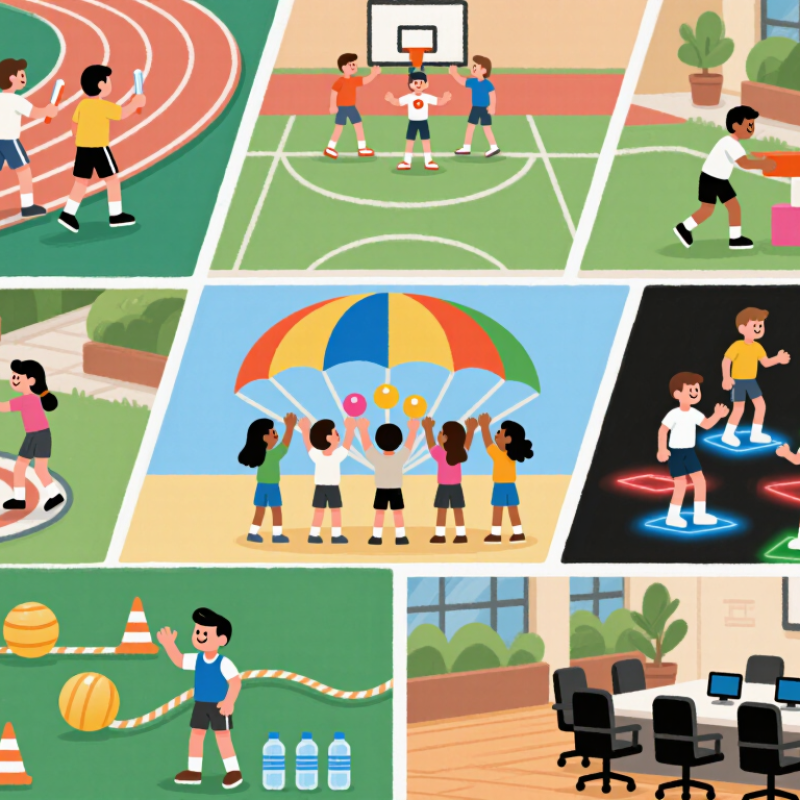
What Makes Interactive Sport Games Effective: WHO’s 81% Youth Inactivity Finding
Top 10 Interactive Sport Games for Schools and Businesses
The World Health Organization reports that 81% of school-going adolescents do not meet recommended physical activity levels. This finding matters beyond sports lessons. Long classroom hours, screen use, and limited public space can make movement feel optional. Interactive sport games create short, visible opportunities to move. A wall-based reaction game can turn a hallway into a ten-minute activity zone. Team relay challenges can also involve employees during breaks. Small changes count.
Effective activities provide clear instructions, adjustable difficulty, and immediate feedback. Motion-based targets, balance tasks, dance challenges, and cooperative obstacle games can support different abilities. Schools should offer seated or low-impact versions. Businesses need safe floors, suitable spacing, and trained supervision. A simple attendance record can show participation. A short wellbeing survey may reveal whether people felt included, not merely tired.
Competition helps some participants. It discourages others. That is easy to overlook. A public leaderboard may reward confidence while embarrassing beginners. Designers and coordinators should test each game with real users, then revise it. The strongest programs mix personal goals, teamwork, and quiet practice. They also protect rest periods and respect individual limits. Interactive sport is not a cure for inactivity. It is a practical invitation to move, especially when the first step feels manageable.
Top 10 Interactive Sport Games for Schools and Businesses
| Rank | Interactive Game | Core Movement | Suggested Format | Recommended Group Size | Primary Effectiveness Features | Easy Inclusion Adaptations | Useful Setting | Engagement Score* |
|---|---|---|---|---|---|---|---|---|
| 1 | Shuttle Relay Challenge | Short runs, acceleration, deceleration, turning, and object transfer. | 4–8 rounds of 30–60 seconds, with 30–60 seconds of recovery between rounds. | Teams of 4–8 participants. | High activity density Teamwork Clear goals | Use walking, wheeling, or low-impact movement options; shorten the distance; allow self-selected pace. | Schools, staff wellness sessions, outdoor events. | 5 / 5 |
| 2 | Four-Corner Movement Game | Jogging, side-stepping, hopping, reaching, and direction changes. | 4–6 movement rounds of 2–3 minutes each. | 8–40 participants. | Frequent decisions Low waiting time Scalable intensity | Replace jumps with reaches or steps; enlarge movement zones; provide visual and verbal signals. | Classrooms cleared for movement, halls, offices, and meeting spaces. | 4.8 / 5 |
| 3 | Target Toss and Move | Walking or jogging to stations, underhand throwing, reaching, and retrieving. | 5–8 stations of 2 minutes each. | Pairs or groups of 3–5. | Skill practice Immediate feedback Personal challenge | Adjust target size and distance; use lightweight soft equipment; permit seated throwing. | Schools, offices, community recreation, and team-building sessions. | 4.5 / 5 |
| 4 | Small-Sided Invasion Game | Running, passing, receiving, defending, spatial awareness, and repeated changes of direction. | 3–5 games of 4–6 minutes, with short breaks. | Teams of 3–5, with rotating substitutes when necessary. | Continuous interaction Communication Tactical thinking | Use walking rules, larger goals, no-contact rules, mixed-ability teams, and rotating roles. | Gyms, playgrounds, sports halls, and large workplace spaces. | 4.9 / 5 |
| 5 | Movement Bingo | Walking, balance tasks, mobility exercises, body-weight movements, and short aerobic bursts. | 15–25 minutes, completed individually or collaboratively. | 4–100 participants. | Self-pacing Choice Easy tracking | Offer seated, standing, low-impact, and higher-intensity versions of every task. | Offices, classrooms, remote teams, and wellness campaigns. | 4.6 / 5 |
| 6 | Capture-and-Return Zones | Jogging, evasion, spatial navigation, object carrying, and cooperative defense. | 3–4 rounds of 5–8 minutes. | Two teams of 5–15 participants. | Social connection Problem-solving High motivation | Use walking-only rounds, safe zones, larger boundaries, and non-contact tagging with a soft marker. | Outdoor fields, gyms, camps, and large activity areas. | 4.8 / 5 |
| 7 | Dance Freeze and Follow | Rhythmic movement, balance, coordination, locomotor patterns, and reaction to cues. | 10–20 movement intervals of 30–90 seconds. | 6–100 participants. | Enjoyment Music cues Low equipment | Permit seated dance, upper-body movements, slower tempos, and participant-led routines. | Schools, offices, indoor events, and warm-up sessions. | 4.7 / 5 |
| 8 | Reaction and Agility Circuit | Quick starts, stopping, lateral movement, balance, reaching, and response to visual or audio signals. | 6–10 stations of 30–45 seconds, with station rotation. | Individual, pairs, or groups of 3–4. | Fast feedback Skill variety Progress tracking | Reduce speed requirements; substitute reaching or seated reactions; use high-contrast visual cues. | Gyms, training rooms, school corridors, and workplace wellness areas. | 4.4 / 5 |
| 9 | Cooperative Parachute Motion | Arm movement, squatting or standing, coordinated stepping, timing, and group rhythm. | 6–10 activities of 1–3 minutes each. | 8–30 participants. | Cooperation Shared success Accessible rules | Adjust handle height, use smaller groups, allow seated participation, and reduce movement range. | Primary schools, team-building activities, and inclusive recreation. | 4.3 / 5 |
| 10 | Adventure Scavenger Walk | Brisk walking, route-finding, object identification, balance tasks, and optional short jogs. | 20–40 minutes, using checkpoints or task cards. | Teams of 2–5 participants. | Moderate activity Exploration Conversation | Provide accessible routes, seated checkpoints, large-print instructions, and non-competitive completion options. | Campuses, parks, offices, community spaces, and school grounds. | 4.5 / 5 |
Evidence sources: World Health Organization, Guidelines on Physical Activity and Sedentary Behaviour, 2020; World Health Organization, Global Action Plan on Physical Activity 2018–2030; Guthold et al., The Lancet, 2019, global trends in insufficient physical activity among adolescents.